HARDWARE · Working prototype
Automated Flow Solid-Phase Peptide Synthesis Platform
Development of an Automated Solid-Phase Peptide Synthesis Platform Based on Flow Chemistry
I turned repeated manual synthesis steps into a sequence in which solutions flow through a reactor and pumps and valves switch automatically.
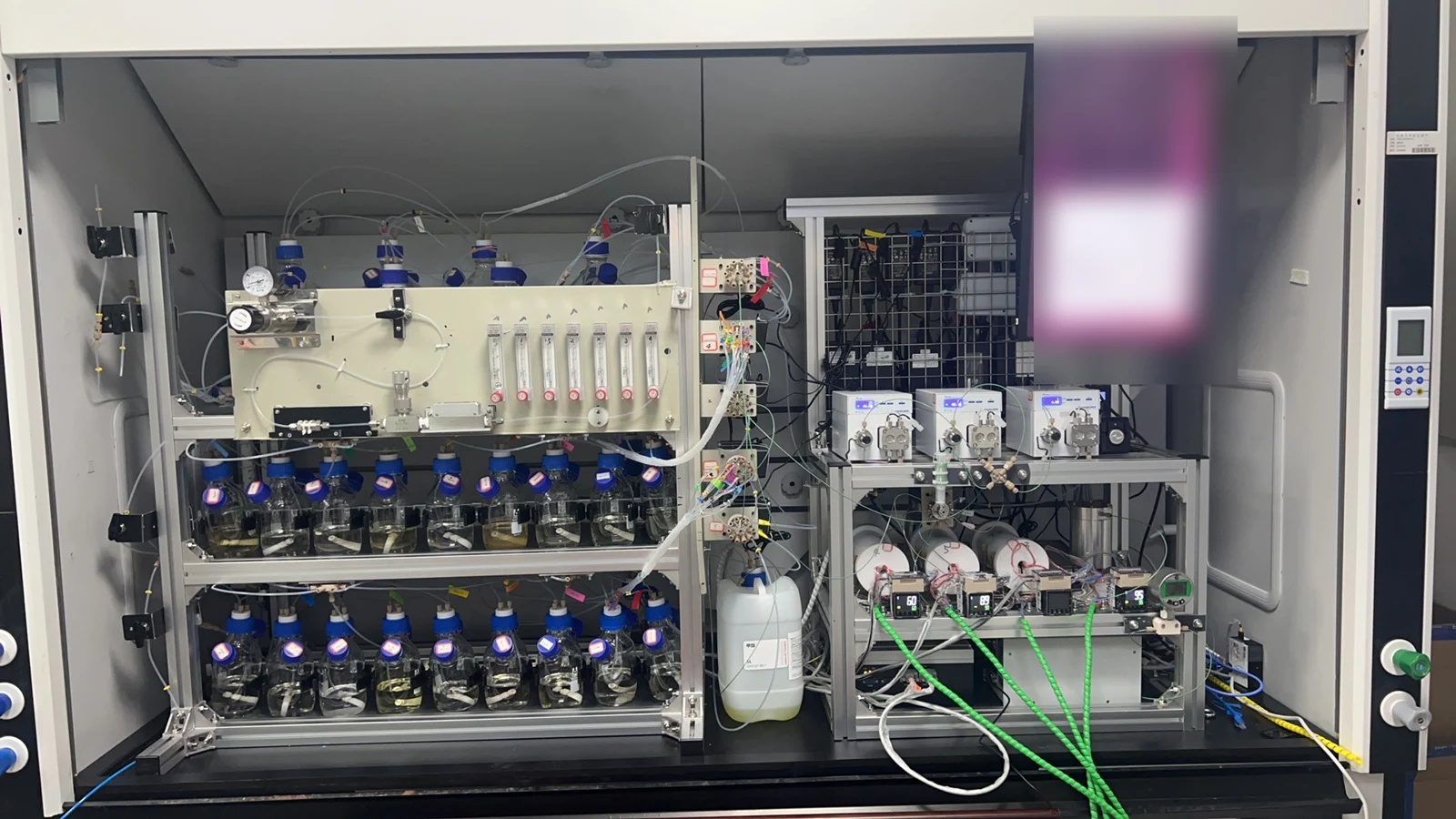
First, decide how the machine should work
Asked to build an instrument from scratch, I studied papers, doctoral theses, and supplier materials, then mapped resin swelling, deprotection, washing, and coupling into an automated flow process. I designed the overall system and selected its components, defining a flow path with three pumps and six valves. I translated bore size, dimensions, pressure and temperature limits, required functions, and control methods into technical requirements.
I defined the system; specialists built to its requirements
I briefed two mechanical, one fabrication, and one electrical-controls collaborator on the actions, form, parameters, and delivery standards needed. They detailed the CAD design, custom fabrication, and low-level drivers. I reviewed the design, moved the work forward, accepted the deliverables, and integrated the instrument. I also wrote 27 high-level control scripts and definition files specifying what the machine should do and when.
Get the machine running for real
Once the parts arrived, I drove assembly, stability experiments, integration testing, and synthesis validation. Core integration took less than three months. The instrument ran repeatedly and demonstrated automated synthesis of a peptide with about ten amino-acid residues. A single coupling operation fell from roughly 30 minutes by hand to roughly one minute, about a 97% reduction in that operation's time. I completed about four formal progress presentations and the final handoff.
More on the process and tradeoffs
Resources and purchasing were part of the design work
I managed roughly RMB 1.5 million in equipment and component resources, coordinated with the requesting team, my supervisor, and nearly 20 suppliers, and handled quantity and inventory planning, quotations, purchasing, and budget coordination. When the original communication and reimbursement chain slowed progress, I aligned with my supervisor and began working directly with the requesting team, so relevant purchases could be paid from its project budget.
Domestic alternatives across pumps, tubing, valves, and small parts
Some imported IDEX and Swagelok components were replaced with domestic parts from suppliers including Runze Fluid and Xiongchuan. For a near-equivalent FEP tube, Runze's actual purchase price was about RMB 7.3 per meter, versus an IDEX public price of about RMB 59 per meter used in the project comparison: about 88% less for that item. This illustrates a component-selection decision; it does not mean every replacement part or the whole instrument cost 88% less.
Approximately RMB 1.5 million is the scale of resources I managed. The 88% comparison applies only to the price of a near-equivalent FEP tube. Operation time is not the total time for an entire synthesis route.
IN MOTION
Flow paths, pumps, and controls.
The machine running on camera